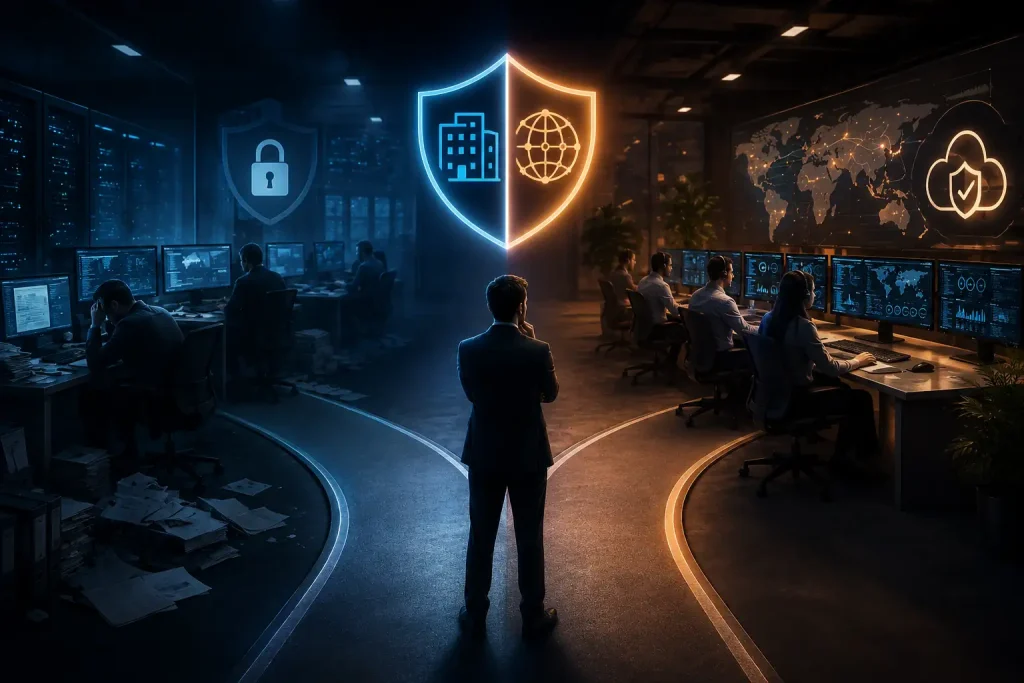
Your business is surrounded by sharks waiting to take a bite of confidential details that can be used against you. So, obviously, you’d invest in building your security team that can mitigate threats. As time passes, you are growing, and the need to cover your business day and night has become an utmost necessity. The question you may be sitting with right now is whether your existing team is capable of covering 24/7 or whether you should invest in a 24/7 outsourced cybersecurity team. There are various cost factors that you must consider, and we will be diving right into it.
The True Cost of Building an In House Cybersecurity Team
Businesses worldwide are expected to spend approximately $6.08 trillion on IT in 2026. This growth extends to cybersecurity and security hiring, with decision-makers projecting a 10–12% increase by the end of the year. As a small or medium organisation, planning how to accommodate a team within your budget range can be tricky. Let us break it down.
Cost Element
Latest Industry Statistic
Why It Increases In-House Costs
Source
Security staffing
33% of organizations say they do not have sufficient resources to adequately staff their cybersecurity teams.
Organizations must continuously recruit or expand teams to maintain 24/7 coverage.
Should SMBs Build an In-House SOC or Outsource Cybersecurity?
After considering the financial and operational demands of building an in-house cybersecurity team, many SMBs find themselves in a difficult position.
They recognise the need for continuous security monitoring but lack the budget to recruit multiple analysts, invest in enterprise-grade security tools, and retain experienced professionals. As cyber threats become more sophisticated and regulations continue to evolve, doing nothing is no longer an option. At the same time, building a fully operational 24/7 security function from scratch is often unrealistic.
Rather than expanding their internal security team indefinitely, SMBs should focus on strengthening their existing capabilities. Their internal IT or security personnel are often better utilised managing business-critical systems, overseeing governance, and driving security initiatives instead of spending nights and weekends responding to alerts. By allowing internal teams to concentrate on strategic priorities, organisations can improve both productivity and overall security maturity.
This is where offshore outsourced security services offer a practical advantage. Instead of hiring additional full-time employees, businesses gain access to experienced cybersecurity professionals who provide continuous monitoring, threat detection, incident investigation, and alert triage around the clock. The organisation avoids lengthy recruitment cycles, recurring training expenses, and the challenges of retaining specialised talent while still benefiting from enterprise-level security operations.
The financial benefits extend beyond reduced hiring costs. Outsourced security providers already have the required expertise, established processes, and mature security platforms in place, eliminating the need for businesses to make significant upfront investments in people and technology. As a result, organisations can convert large capital and staffing expenses into predictable operational costs that scale alongside business growth.
Also read : Top 10 Benefits of Partnering with a White Label SOC Provider
In House vs Outsourced Cybersecurity: Side by Side Comparison
Criteria
In-House Security Team
Outsourced Offshore Security Services
Initial Investment
High recruitment, onboarding, and infrastructure costs
Minimal upfront investment with predictable onboarding
24/7 Coverage
Requires multiple shifts, overtime, and additional headcount
Continuous monitoring provided as part of the service
Recruitment
Lengthy hiring process in a competitive talent market
Immediate access to experienced security professionals
Employee Retention
High risk of turnover and salary inflation
No recruitment or retention responsibility
Scalability
Hiring additional analysts can take weeks or months
Scale services up or down based on business requirements
Operational Overhead
Internal management, scheduling, compliance, and performance monitoring
Provider manages staffing, scheduling, and operational delivery
Cost Structure
High fixed costs that increase with team expansion
Predictable monthly operational expense
Is Outsourced Cybersecurity the Right Choice for Your Business?
Protecting your business shouldn’t drain your budget. Stop struggling with the high costs of recruitment, training, and retention for an in-house team. Switch to a smarter approach with outsourced cybersecurity services. Gain access to 24/7 expert monitoring, mature security platforms, and predictable operational costs, all while empowering your team to focus on strategic growth. Ready to secure your future for less? Contact us today to optimize your cybersecurity strategy.
Sreekanth is the Technical and Professional Services Manager at Secucenter. With over 12 years of expertise in safeguarding IT infrastructures across on-premises, hybrid, and cloud environments, he is dedicated to enhancing security measures. Sreekanth's innovative mindset drives him to develop robust and resilient cybersecurity frameworks.
Sreekanth is the Technical and Professional Services Manager at Secucenter. With over 12 years of expertise in safeguarding IT infrastructures across on-premises, hybrid, and cloud environments, he is dedicated to enhancing security measures. Sreekanth's innovative mindset drives him to develop robust and resilient cybersecurity frameworks.
News
Security News & Threat Updates
Jul 30, 2026 |
Aug 05, 2026 |
4 min
|
562 views
Bank of Baroda Data Breach: 700 GB to 1 TB of Alleged Banking Data Leaked
Bank of Baroda data breach has placed India's banking sector under the...
Most breaches begin with a gap no one was watching. Tell us what you're protecting and our SOC analysts will pressure-test your defenses and show you exactly where you stand.
Level 17, TransAsia Cyber Park Kochi, Kerala-682030
Data privacy notice.
All submissions are protected via TLS 1.3 encryption in transit and
processed within our secure, air-gapped data environment. We never resell your data.






 For active security incidents only.
 Aug 10, 2026

 5 min
5 min
 32 views